PAT testing 110V site equipment needs a tighter regime than low-risk office kit: HSG107 suggests weekly user checks, monthly formal visual inspection, combined inspection and testing before first use on site, then every three months. For 230V construction equipment: daily or each-shift user checks, weekly formal visual inspection, combined testing before first site use, then monthly. These are guidance, not statutory deadlines. Check the transformer, leads, tool and supply, not just the appliance.
1. Start at the transformer
Use cordless tools or HSE's recommended 110V centre-tapped-to-earth supply, with maximum voltage to earth no greater than 55V. A yellow plug is not itself the protection: colour proves neither supply arrangement nor equipment condition.
Register transformer, input lead and plug, output sockets, extensions and tools. HSG107 includes extension leads, plugs, sockets and cord sets because they share the equipment's environment and use.
Assess the transformer separately: neither its pass nor the tool's establishes the other's condition. Have a competent person confirm type, model instructions and assessment; HSE says to use equipment for its intended purpose, in its designed environment and according to manufacturer instructions. Arrange who releases it and dependent tools; keep separate records when either changes.
2. Follow the lead
Treat the supply cable as vulnerable: HSG107 calls it often portable equipment's most vulnerable part. Repeated flexing can fracture conductors and crack sheaths, often starting at plug or equipment entries.
Disconnect safely; inspect the full accessible length, connectors and entries for cuts, heavy scuffing, taped joints, exposed inner cores, damaged plugs, loose parts and overheating — HSE inspection signs. Do not investigate live equipment or trust a running motor and intact tool body.
3. Identify the tool
Choose for conditions, not connector fit: HSE says DIY or domestic tools, plugs and cables are unsuitable for sites and damaged power tools must leave service.
Identify construction, not voltage or plug colour: Class I relies on effective protective earth; Class II uses high-integrity insulation without an earth connection for safety. Have the tester select the method, not one toolbox-wide routine; see Class 1 and Class 2 appliances.
4. Stop damage and abrasion
Check enclosure, leads, connectors and entries for damage, loose parts, contamination and overheating: HSG107 user-check categories. Stop and report damage or unsuitable exposure; do not open live equipment.
Protect and reroute cables dragged over abrasive surfaces or traffic routes; another sticker is not the answer. Keep faulty kit out until competently repaired; combined inspection and testing may be justified after repair or modification. HSE discourages makeshift repairs. Construction-site PAT testing supports maintenance; it does not replace everyday handling and storage control.
5. Keep water in the assessment
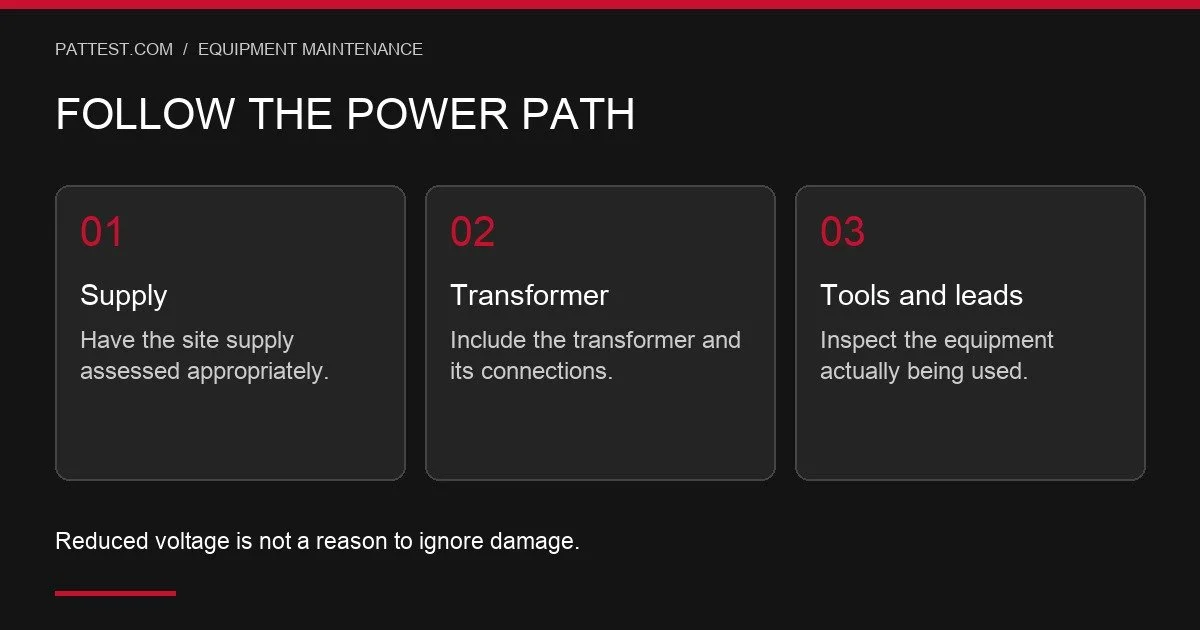
Flag wet kit, mud, dust and excessive contamination; HSG107 says environment and mechanical-damage likelihood must influence maintenance. Do not treat reduced voltage as permission to ignore defects.
6. Ask what each test answers
Use combined inspection and testing for invisible defects: HSG107 names lost earth integrity, deteriorating insulation and contamination. Require competent interpretation, not operation of a pass/fail display.
Ask continuity checks about the protective earth path where applicable; Class I needs that path, Class II does not use that arrangement. Ask insulation checks about insulation condition: these address different failures, neither displaces the other merely because a tool is 110V, and methods must suit equipment.
7. Separate RCD protection from an appliance pass
Remember: HSE says RCDs detect some, not all, electrical faults and rapidly disconnect supply. Its construction guidance requires proper installation and enclosure, daily checks, freedom from moisture and dirt and protection from vibration and mechanical damage.
Have a competent person confirm actual site-distribution protection. Testing a drill does not verify that distribution.
8. Read the site intervals correctly
Use HSG107 Table 1, third edition (2013), for suggested initial construction intervals. These columns were checked against the actual PDF in November 2026:
- 110V: weekly user checks; monthly formal visual inspection; combined inspection and testing before first use on site, then every three months.
- 230V: daily or each-shift user checks; weekly formal visual inspection; combined testing before first site use, then monthly.
Treat these as suggestions, not legal requirements. Assess damage or deterioration conditions and review actual faults; punishing work may need closer attention. Weekly does not mean ignore damage until Friday: HSG107 says check on taking into use and during use, report faults and withdraw immediately. Use a pre-use look alongside the schedule; handlers can spot new cuts or loose plugs.
9. Keep site records separate from workshop assumptions
Record asset ID, description, voltage, established class, usual location, inspection and test history, faults, withdrawal, repair and return decisions: recommended fields, not a prescribed form; HSE calls records useful, not generally legally required. Make evidence accessible at the workface; name who checks hired-tool history, stops use and quarantines failures. HSE strongly recommends supplier inspection and testing before each hire; hirers must also maintain safety during hire.
A workshop is not automatically an office or a construction site: choose by its actual environment, not the business name. HSG107 gives high-damage-risk heavy industry daily user checks, weekly visual inspection and six-to-twelve-month combined testing; light industry has another row. Low-risk INDG236 allows rarely moved desktops two-to-four-year formal visual inspections, no combined test if double insulated, otherwise up to five years: risk and use explains the difference.
Reassess workshop tools entering sites, including before-first-use arrangements. Separate construction and office kit when booking PAT testing; disclose voltages and transformers. Use your own patterns — damaged leads, unsuitable kit, repeat failures or handling — rather than assuming which failure dominates: HSG107 recommends fault patterns to improve maintenance and intervals.
Based in Kettering, PatTest.com provides PAT testing for construction equipment and businesses throughout Northamptonshire, Leicestershire, Warwickshire, Bedfordshire, Buckinghamshire and the wider Midlands.