No statute demands a document called a PAT testing policy. The law requires safe maintenance and risk assessment; employers with five or more employees must record significant risk-assessment findings and health-and-safety arrangements. The following policy sets out how a business can organise those duties, rather than treating paperwork as maintenance. Complete every bracketed field, agree arrangements with the people named and keep the supporting register accessible; do not sign while responsibilities or intervals remain undecided.
1. Scope
1.1 [Business name] shall apply this policy to portable and movable electrical equipment used for work at [premises and other locations]. Include approved personal equipment, shared items and equipment used away from the office.
1.2 Maintain the equipment and custodian list at [register location]. Keep laptops, chargers and loaned extension leads within scope when they leave the building.
2. Responsibilities
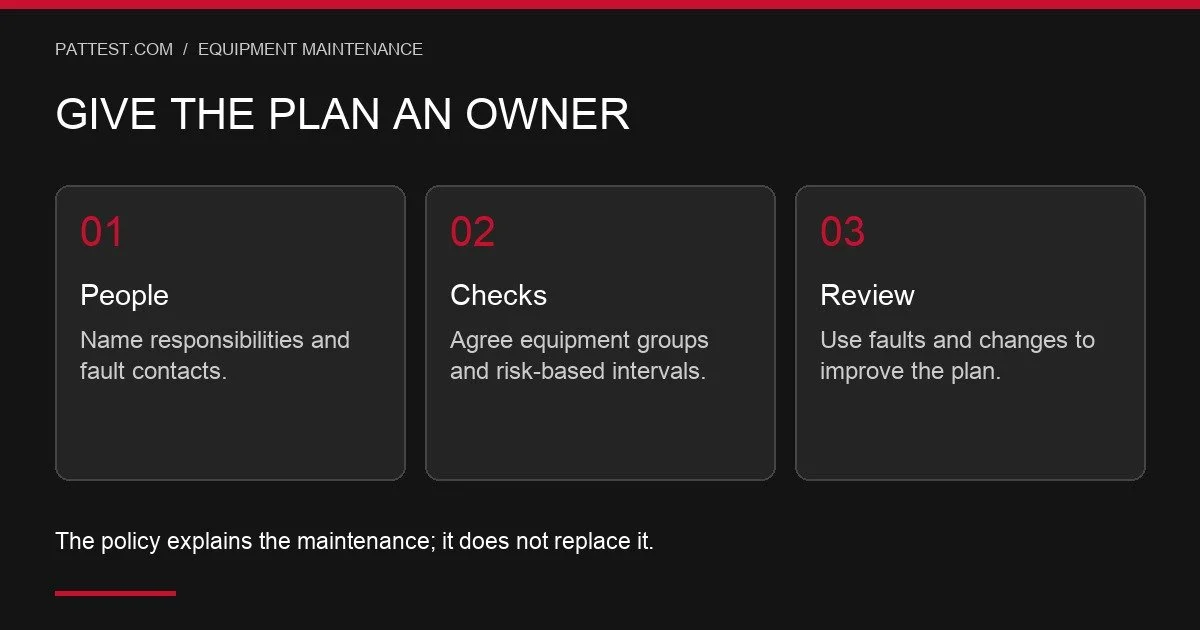
2.1 [Named manager or role] shall own the maintenance plan, approve risk-based intervals and arrange equipment access. [Deputy] shall cover absence.
2.2 Users shall report damage to [contact] and shall not use equipment they suspect is unsafe. Name a custodian for shared equipment rather than assigning responsibility to “everyone”.
3. Competence
3.1 Give users simple pre-use damage-check instructions where appropriate. Assign formal visual inspections to [competent person or role].
3.2 [Competent testing provider] shall carry out combined inspection and testing where required. Require suitable methods and interpretation of results, not simply recorded display readings.
4. Intervals
4.1 Keep the assessment and schedule at [assessment or schedule location]. Group equipment by construction, use and environment, recording user-check, formal visual-inspection and testing arrangements, reasons and manufacturer instructions considered.
4.2 Record construction, handling, location and likelihood of damage when assigning each group. The manager shall review intervals using faults and changes in use, not impose an automatic annual cycle.
4.3 Address repeated cable damage through routing and handling as well as considering shorter intervals. Do not let plug count decide the programme; use the Class 1 and Class 2 distinction when considering equipment construction.
5. Contractor and tenant equipment
5.1 Agree responsibility for hired, leased, personal and shared equipment before use. Refer unknown or unassessed items to [role], rather than assuming that equipment is safe because someone brought it in.
5.2 Establish what incoming equipment is, who uses it and who deals with defects. Where a contractor supplies and uses its own tools, agree the site interface without treating this register as a replacement for its arrangements.
5.3 Tell contractors, agency staff and borrowers how to report defects. Brief agency staff on their first shift about the contact, withdrawal and who authorises return to use, rather than waiting for a red sticker.
5.4 Keep loan equipment in the register while away and require damage reporting on return. Do not assume the supplier handles all maintenance where staff use supplied equipment.
6. Faults
6.1 Withdraw suspect or failed equipment without delay, identify it and place it in [controlled location]. [Responsible role] shall arrange competent repair and checks before return to service, or disposal preventing further use.
6.2 Users shall not make unauthorised repairs or return quarantined equipment to use. Keep outstanding faults visible until resolved.
7. Records
7.1 [Record owner] shall keep the register, inspection and test results, faults and repair decisions at [location]. Connect asset ID, description, location, inspection or test date, result, relevant readings, faults, repairs and next planned action.
7.2 Set [retention period and rationale] as the business's chosen arrangement, checked against contract and insurance terms. Retain enough history to recognise recurring damage and changed intervals; do not delete unresolved failures because a new visit generated another PDF.
7.3 Answer audit and insurance enquiries against the actual questions and terms, showing assessment, responsibility, checks and fault resolution. Clarify ambiguity rather than assuming every insurer requires annual testing or labels on every item.
8. Review
8.1 [Policy owner] shall review this policy on [date], and earlier after significant changes, concerns about the assessment or repeated faults. Record approval by [name and date].
8.2 Give the provider equipment groups and requirements when booking PAT testing. Agree inspection and testing scope, how unavailable equipment is recorded and how failures are communicated.
8.3 Keep assets, groups, intervals and people in the supporting schedule, not all on this policy page. Make both usable by a deputy without the writer's explanation; require reports to support this policy, not substitute the provider's diary date.
Notes on the clauses
Legal footing. This is practical wording, not a statutory template. In Great Britain, Electricity at Work Regulations 1989 regulation 4(2) requires systems maintained as necessary to prevent danger, so far as reasonably practicable. The Provision and Use of Work Equipment Regulations 1998 (PUWER), regulation 5, require work equipment maintained in an efficient state, efficient working order and good repair. Neither sets an annual PAT timetable.
Management of Health and Safety at Work Regulations 1999 regulation 3 requires suitable and sufficient risk assessment. Employers with five or more employees must record significant findings and especially-at-risk groups. Regulation 5 requires planning, organisation, control, monitoring and review arrangements, recorded by those employers. That threshold does not require an appliance-by-appliance PAT certificate.
HSE says inspection and testing records and labels are not generally legally required, though useful management tools. Separately, PUWER regulation 5(2) requires an existing machinery maintenance log kept up to date. This position was checked in November 2026; HSE guidance and industry codes are not legislation. See the annual-testing distinction.
Risk-based intervals. HSE bases frequency on equipment and environment. INDG236 revision 3 (2013) supplies suggested initial intervals, not universal annual testing:
- Rarely moved desktop computers and screens: formal visual inspection every two to four years; no combined test if double insulated, otherwise up to five years.
- Hand-held double-insulated equipment: formal visual inspection every six months to one year; combined testing not normally needed.
- Earthed Class I equipment, such as kettles: formal visual inspection every six months to one year; combined inspection and testing every one to two years.
The table also recommends user checks for the latter two groups. The leaflet is for low-risk environments: do not transfer those intervals to wet workshops, construction sites or heavily handled loan fleets. HSE recommends reviewing results to decide whether checks and testing should be more or less frequent.
Equipment and evidence. INDG236 includes employees' own and employer-supplied equipment used at work. It describes joint responsibility for leased equipment and contractor-provided equipment employees use, distinguishing equipment both supplied and used by a contractor. The arrival and reporting clauses make responsibility visible, not create separate legal duties to label or complete forms.
HSE says records can help demonstrate a maintenance scheme and monitor its effectiveness. The listed fields are suggestions, not a prescribed PAT form; there is no universal statutory PAT retention period. An annual certificate alone cannot explain a high-use item's long interval or show whether a failed appliance was repaired.
PatTest.com offers PAT testing for businesses, landlords and premises managers in Northamptonshire, Leicestershire, Warwickshire, Bedfordshire, Buckinghamshire and the wider Midlands, working from Kettering.