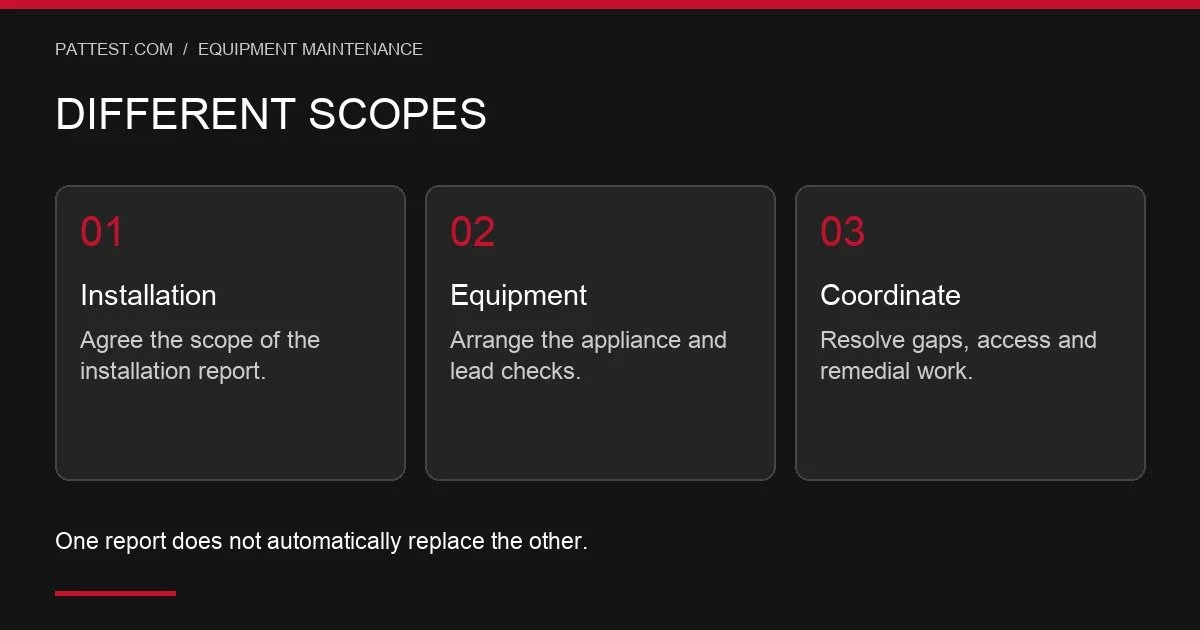
PAT testing and an EICR cover different things: the EICR assesses fixed circuits, socket-outlets, the consumer unit and earthing, while PAT examines equipment and its leads. Neither replaces the other. Hardwired appliances can need in-service equipment checks too, so a plug alone does not define the boundary. In England, agree both scopes before booking to avoid duplicated work and unchecked appliances. The comparison below reflects legislation and government guidance checked in November 2026, not a single UK-wide landlord regime.
What each one covers
- EICR: the installation. The legal starting point is the Electrical Safety Standards in the Private Rented Sector and Social Rented Sector (England) Regulations 2020, SI 2020/312, as amended. Regulation 2 refers to the Building Regulations 2010 definition of “electrical installation”, meaning “fixed electrical cables or fixed electrical equipment located on the consumer's side of the electricity supply meter”.
GOV.UK describes wiring, sockets, light fittings and the consumer unit, including permanently connected showers and extractors. Earthing and bonding are protective arrangements, not desk-inventory items.
- PAT: the equipment. Regulation 2 separately defines electrical equipment as “those electrical fixtures, fittings and appliances that are not electrical installations”. HSE uses PAT for examination of electrical appliances and equipment to check safety. The unit of work is the appliance and lead, not its supplying circuit.
This is not “screwed down versus loose”, and PAT is not the statutory name of an alternative housing inspection. Establish what is being maintained and inspected, rather than expecting two abbreviations to settle every boundary.
What each report records
- EICR: installation inspection and test results and the next-inspection date. Read observations and agreed limitations, not merely “satisfactory”; query scope that does not fit the premises or equipment described. GOV.UK defines C1 as danger present, C2 as potentially dangerous, C3 as improvement recommended and FI as further investigation required without delay. C1, C2 and FI require action; C3 alone does not make the report unsatisfactory.
- PAT: request identifiable items, locations, inspection outcomes, relevant measurements, defects and actions. HSE describes records and labels as useful management tools without imposing a universal record-keeping requirement in its general workplace PAT guidance. A kettle sticker is not an EICR, and “all items passed” offers little maintenance detail.
- Social-landlord equipment checks: GOV.UK says records should give results and the next-check date where equipment is safe; possible contents include equipment identity, condition, environment and findings. HSE's general PAT statement does not remove that separate housing-law obligation.
Both sets of paperwork should identify the correct premises; any separate remedial confirmation should match the report.
How often each is required
- EICR: for tenancies within the England Regulations, regulation 3 requires qualified-person inspection and testing at no more than five-year intervals. An earlier date required by the latest report takes precedence. Five years is a maximum, not permission to ignore deterioration.
- PAT: HSE bases frequency on equipment and environment and rejects a legal annual test for every appliance. A five-year installation cycle says nothing about when a supplied fridge or shared toaster needs examination.
The regulations require installation inspection and testing before the specified tenancy begins. They do not demand a fresh EICR at every tenant change: GOV.UK allows an existing report less than five years old without required investigative or remedial work, supplied to the incoming tenant. It recommends a visual inspection before a new tenancy to check for damage or deterioration.
Where the report identifies the relevant breach or potential breach and requires investigation or remedial work, regulation 3 requires completion within 28 days of inspection and testing, or sooner if the report specifies. Follow the finding's urgency and make hazards safe, rather than treating four weeks as permission to wait. Obtain the qualified person's written confirmation afterwards and provide it with the original report to existing tenants and the local housing authority within 28 days of completion. Diary follow-up separately: filing an unsatisfactory report does not complete the process.
Since the 2025 amendments, registered social landlords must also have supplied electrical equipment checked by a qualified person at least every five years. That may be visual inspection, testing or both, as the qualified person considers necessary for continued safety. Private landlords do not thereby acquire an annual PAT rule: check applicable tenancies, licence conditions and contracts.
Who is competent for each
- EICR: regulation 3 defines a qualified person through competence in inspection, testing and relevant investigative or remedial work to the electrical safety standards. Choose someone competent in periodic inspection of that installation; operating a plug-in tester does not automatically qualify someone to issue an EICR.
- PAT: HSE requires the right equipment, ability to use it properly and understanding of results. A trained, competent employee may visually inspect in many low-risk environments; combined inspection and testing requires greater knowledge and experience. A short course alone does not demonstrate competence for every appliance or setting.
Long leads, electronic controls and permanently connected equipment can need different arrangements. Agree access, safe isolation, reinstatement and specialist exclusions when seeking comparable quotations. Legislation creates duties; BS 7671 is the British Standard referenced for housing electrical safety standards, not an Act of Parliament. The IET's in-service Code is equipment-safety guidance, and manufacturer instructions inform product-specific work.
What neither one proves
- EICR does not prove appliance safety. Checking a socket and circuit does not establish a kettle's flex, plug, insulation or protective earth.
- PAT does not prove installation safety. An appliance pass does not establish concealed wiring or consumer-unit protective arrangements.
The IET warns of an EICR stopping at a fused connection unit or isolator while an appliance tester assumes hardwired equipment belongs to the installation. The equipment may still need in-service maintenance regardless of mobility. A built-in oven or hardwired hand dryer must not disappear between contractors; equally, do not duplicate a suitable existing maintenance regime. Agree a written boundary covering installation inspection, equipment checks and specialist servicing: who checks beyond the isolator, and where is it recorded? Our PAT testing service helps identify equipment scope; agree specialist knowledge or safe isolation before treating it as a plug-in visit.
Arranging both together
Manage installation and supplied appliances together without inventing annual PAT law. HMOs do not make inspections interchangeable: GOV.UK says the Regulations cover shared homes whose different households share facilities. Council appliance-evidence requirements vary, so check licence conditions and other management duties. See the HMO compliance calendar and landlord PAT guide.
Review the installation report and appliance inventory for overdue work and defects; coordinate contractors, isolation and access so tenants need not empty the same cupboard twice. Appliance checks need not await the next five-yearly EICR, and urgent installation defects must not wait for a convenient combined booking.
Based in Kettering, PatTest.com arranges PAT testing across Northamptonshire, Leicestershire, Warwickshire, Bedfordshire, Buckinghamshire and the wider Midlands.