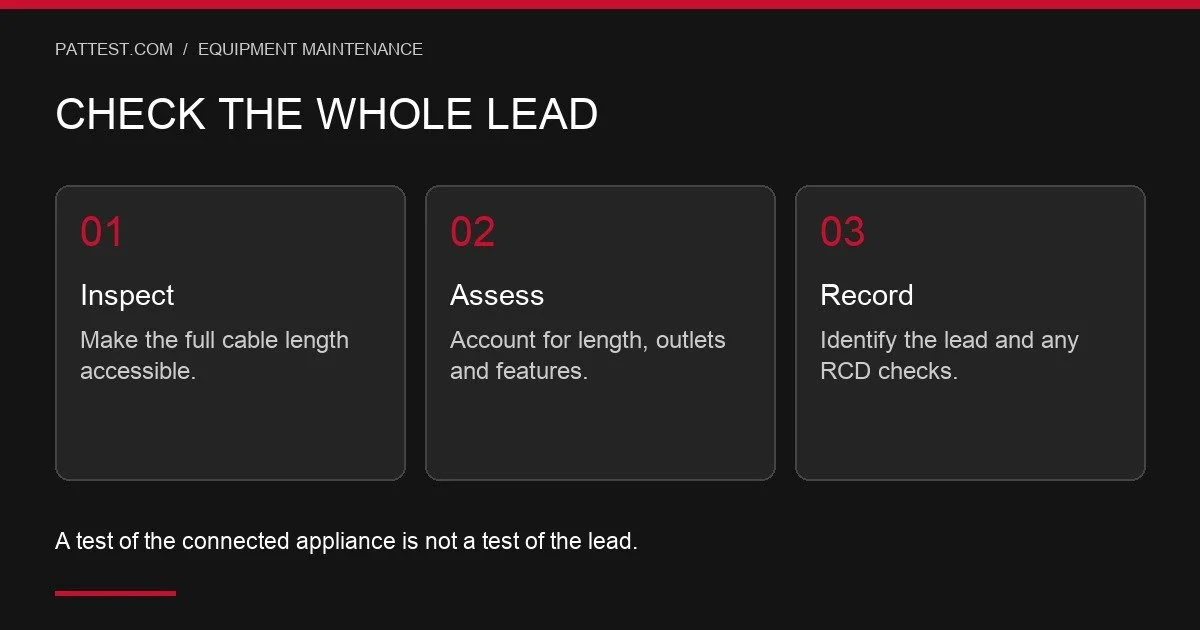
Yes: extension leads with an RCD need PAT checks on the lead and a separate check of the RCD's operation. An earthed extension is Class I equipment: visual inspection, earth continuity, insulation resistance, polarity and a functional check. The RCD plug needs its own operation check, while a long lead's earth-continuity limit is (0.1 + R) ohms, not a fixed figure that ignores length. The useful question after a result is what caused it, not simply which label to attach.
When the earth reading climbs with length
A sound 25 m or 50 m lead can read higher than a short desk extension without defective insulation or a broken earth. The practical PAT guide used by test-instrument manufacturers sets out earth-continuity, insulation-resistance and wiring-polarity checks for extension leads and multi-way adaptors, with conductor-resistance tables by cable size and length and a maximum earth-continuity reading of (0.1 + R) ohms.
R is the cable's protective-conductor resistance, not its live-and-neutral loop resistance. More copper length means more resistance: the formula describes expected resistance, not tolerance for poor connections. Applying 0.1 ohm indiscriminately can turn a sound 50 m reel into a failure on paper. A length-blind fail display needs investigation, not automatic scrapping; raising the limit until damaged cable passes is equally wrong.
Check length, conductor size, equipment settings and test connections. The guide stresses clean metal-to-metal contact for earth-continuity measurements, because dirty contacts or a poor adaptor can mislead. An unexpectedly high reading still needs resolving once those factors are accounted for.
Keep earth continuity and insulation resistance in separate record columns. For an ordinary Class I extension, the reported guidance minimum insulation resistance is 1 megohm, not the earth test's low-resistance limit. Neither result substitutes for the other; higher expected earth resistance does not itself show poor insulation.
When an RCD does not trip
A lead can pass earth and insulation checks while its RCD trip mechanism remains unproven. The practical guide says to confirm correct RCD operation and describes instrument testing of trip time. The lead and protective device answer different safety questions.
Use the test button as often and in the manner the manufacturer specifies. If the device will not trip, will not reset correctly or shows damage, stop using it and obtain competent advice. A button check is functional, not a measured trip-time result.
For instrument testing, identify the RCD type and appropriate method and acceptance criteria. The guide distinguishes device standards and trip-time limits, so an unexplained “RCD pass” setting cannot replace identification. Follow manufacturer instructions and current guidance, particularly with instruments offering several modes; record the chosen mode.
Do not ask untrained staff to improvise live tests or bypass the RCD. HSE says combined inspection and testing needs appropriate equipment, the ability to use it properly and the ability to understand results. Record whether the result covers a button check, an instrumented check or both.
When a reel is tested coiled
Two questions are being confused: whether the cable has been inspected, and whether it can carry its intended load. Unwind it for inspection so abrasion or makeshift repairs cannot remain hidden. The manufacturer's guide says to check extension leads along their entire length, identifying cuts, fraying, overheating, incorrect fuses, insecure cable grips and unsafe taped joints.
Under load, heat is the concern. HSE's electrical guidance for entertainers says only fully extended leads can carry their full current capacity without overheating and instructs users to unwind drums or coils fully to avoid fire risk. Follow the reel's instructions and separate wound and unwound ratings: safe current in a tight coil is not safe current on the ground.
Coiling does not remove protective-earth copper or avoid long-lead resistance. Assess the actual length and size. A brief earth-continuity test does not prove a reel safe for a heavy load all afternoon: the result describes it as presented that day, not its subsequent coiling habit or load. Make it accessible before the visit, follow reel and instrument instructions for powered functional checks, and never deliberately load a coiled reel to see whether thermal protection trips.
When the plug or cable shows damage
Do not connect visibly dangerous equipment merely to see whether it passes. Inspect the plug, socket block, reel, cable entry and entire cable, not just the accessible end behind stored equipment. Cover every multi-socket outlet, switches, damaged shutters and loose parts; identify the lead clearly enough to find it after furniture moves. Our PAT testing service includes leads as well as their appliances.
Older non-sleeved plugs are a separate inspection question that an RCD label cannot settle. A lead driven over, trapped in a door or repaired with tape needs immediate attention whatever its label says. Separate failed equipment so it cannot return to a cupboard and reappear at the next event.
When a surge strip needs a different test
A standard full-voltage sequence is not automatically appropriate. The practical guide warns that surge-protection components can be affected by 500V DC insulation testing and describes reduced-voltage testing, such as 250V DC, or appropriate alternatives. A suitable lower-voltage instrument mode must follow equipment and instrument instructions, not become a way to turn failure into a pass. See surge-protected devices failing PAT testing.
When the result belongs to 110V equipment
Reduced voltage does not remove maintenance needs: the practical guide covers 110V and 230V equipment. Identify leads and connectors and use suitable equipment and adaptors. A yellow connector proves neither earth condition nor correct internal wiring.
Record the transformer and each output lead separately so failures can be traced. The manufacturer's transformer guidance starts with visual inspection, follows with appropriate Class I tests for the transformer shown, and recommends checking every output socket and its operation. The sequence must suit both transformer and instrument, not become one unexplained certificate entry.
How many leads to allow for
Count desk blocks, meeting-room extensions, cleaner's leads, stored reels, temporary equipment and outdoor leads. HSE's INDG236 includes extension leads and multi-way adaptors and says cables not dedicated to an appliance should, where appropriate, be maintained individually. An inventory rather than an appliance headcount supports budgeting, fault-history review and comparable quotations; include long reels, RCDs and 110V equipment when agreeing scope and access.
Its low-risk table suggests initial visual inspection between six months and four years and combined inspection and testing between one and five years, depending on equipment served. These are neither construction-site intervals nor legal deadlines; HSE says frequency depends on equipment and environment. Use shorter intervals or a more demanding regime where risk assessment supports it, reviewing repeated damage, outdoor use and frequent relocation.
For PAT testing that includes your extension leads, PatTest.com serves Northamptonshire, Leicestershire, Warwickshire, Bedfordshire, Buckinghamshire and the wider Midlands from Kettering.