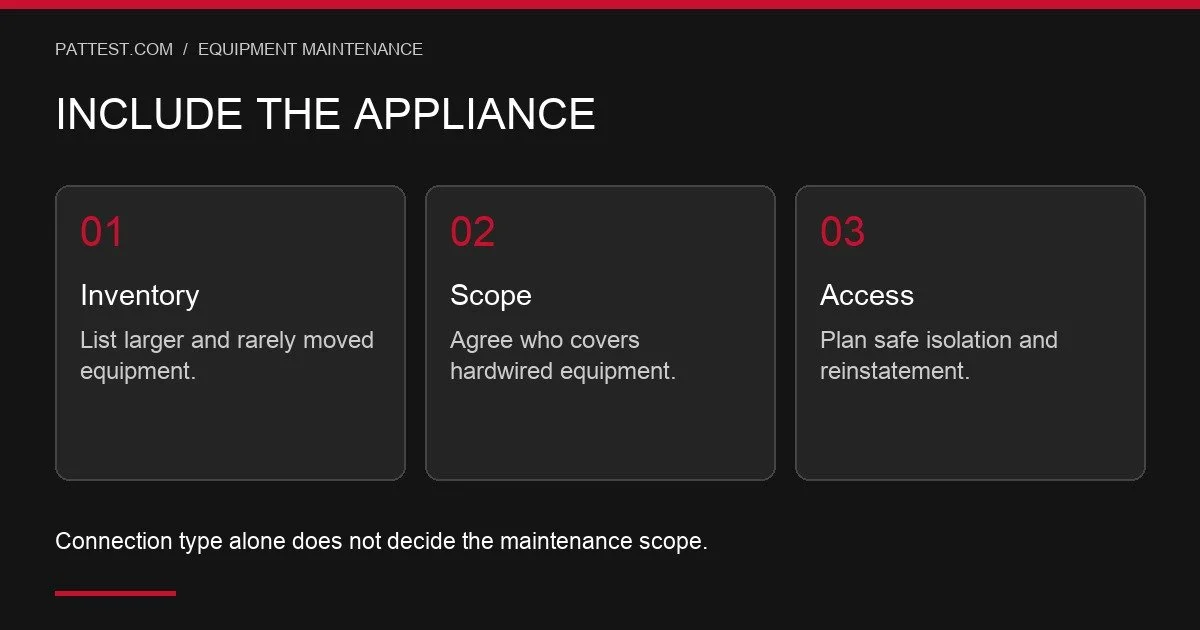
Yes: plug-connected kitchen appliances belong in appliance safety arrangements, including heavy or rarely moved fridges. Hardwired appliances can need in-service checks too; an EICR is not automatically a substitute. Inspection and testing intervals follow construction, use and risk, not a universal annual rule. Find the appliance below, then confirm its connection before agreeing the work.
Scope, appliance by appliance
Fridge — In scope as portable equipment.
HSE's low-risk guidance includes fridges, washing machines, microwaves and electric cookers as movable equipment, even when rarely moved. Scope follows what you supply or control, not what one person can carry; reaching behind a cabinet to unplug a fridge does not exempt it. Record the appliance, location, connection and access difficulty: the register helps contractors plan and shows what was included.
Freestanding oven and hob — Depends on how it is connected.
Check whether it plugs into a socket or uses a fused connection unit before choosing a contractor; built-in status alone establishes neither safety nor maintenance responsibility. With Class I equipment, protection depends on insulation and a protective earth: HSE warns that an internal fault could make the outside capable of giving a shock without the earth connection. HSE recommends testing Class I equipment to ensure that connection is sound, while appropriate insulation or leakage checks must account for electronic controls rather than treat every appliance identically.
Gas cooker — Depends on how it is connected.
Gas heat does not remove the electrical parts from consideration: mains-powered ignition, a clock or an electronic timer still need attention, and manufacturer instructions for a gas-hob cooker describe spark ignition, a digital timer and a mains connection. Check the actual model because arrangements differ. An electrical safety check is not a gas safety examination, nor vice versa.
Washing machine — In scope as portable equipment.
Heat, cleaning chemicals, water and movement matter here; HSE says visual examination is essential to PAT because testing alone cannot detect some electrical safety defects. Its inspection guidance includes damaged flex, trapped cables, cracked plugs, visible inner wires, unsuitable wet or dusty conditions and overheating. Look for a trapped cable, scorched plug or grease and contamination reaching electrical parts: these are inspection prompts, not claims about fault frequency.
Dishwasher — In scope as portable equipment.
Cover the whole appliance, not the easiest part to reach: supply, controls and door interlock are one identifiable register item, traceable after a refit. A competent rewirable-plug inspection covers terminals, the correct fuse and cord grip; HSE says the grip must hold the outer sheath, not inner wires. A missing grip, loose terminal or wrong fuse is not excused by good insulation readings; moulded plugs allow only the fuse to be checked internally.
Microwave — In scope as portable equipment.
A countertop microwave moved for cleaning is the simplest kitchen case, but identify its construction class from markings and instructions. Genuine Class II equipment does not need the Class I earth test; a Class I microwave's protective earth matters as much as a cooker's. A plastic casing or control panel does not establish double insulation: see Class I and Class II appliances.
Hardwired or fused-spur appliance — Depends on how it is connected.
Outside the ordinary portable-appliance regime does not mean automatically covered by the installation inspection: the IET's fifth-edition Code explanation warns that an EICR inspector may stop at the fused connection unit or isolator while the appliance tester excludes everything beyond a plug. Its approach covers equipment not already maintained under another regime, movable or fixed. Before writing “fused spur — covered by EICR”, agree who inspects the appliance, flexible cable and connection; safe isolation and equipment-testing competence may be needed beyond a plug-in visit, avoiding both gaps and duplication.
Intervals and access notes
HSE's INDG236 revision 3, published in 2013, suggests initial low-risk Class I intervals, including some kitchen equipment: user checks, formal visual inspection every six months to one year, and combined inspection and testing every one to two years. These are guidance starting points, not statutory deadlines, a fridge-specific annual rule, a timetable for every commercial kitchen or domestic-tenancy law. HSE says frequency depends on equipment and environment.
Compare a restaurant appliance moved for cleaning beside hot surfaces and repeated splashes with a rented-flat fridge whose cable stays protected. Higher commercial risk may justify shorter intervals, but “commercial” is not itself a frequency; damage or repeated trouble also defeats an assumed long interval in a flat. HSE recommends adjusting intervals up or down using inspection results and reported faults. Testing records condition at that time; user checks and prompt fault reporting remain necessary between visits. Act on a new burning smell or damaged flex immediately.
Flag integrated units, full freezers, sockets hidden behind stock and opening-hour interruptions. Agree isolation, restoration and who confirms refrigeration is running afterwards. Never pull a heavy appliance by its cable or disturb connections to place a label. Our PAT testing service helps establish the appliance-and-lead register and scope before the visit.
Landlord position
In England, as checked in November 2026, regulation 2 of SI 2020/312 defines electrical equipment separately from installations and refers to the Building Regulations installation definition. Installation inspection is not a blanket white-goods certificate; GOV.UK says supplied installations and equipment should be safe initially and checked regularly.
The old “installations only” shorthand needs qualification: following the 2025 amendments, registered social landlords must have supplied equipment checked by a qualified person at intervals no longer than five years. This does not impose annual PAT on private landlords: check tenancy, licence conditions and contracts, rather than borrowing another sector's rules. The landlord PAT guide explains responsibilities; an inventory prevents failed appliances returning at the next letting.
Repair or replace
HSE says remove faulty equipment without delay, then have it competently repaired or dispose of it to prevent reuse. Repair suits a correctable defect whose safety can be verified afterwards; replace where parts are unavailable, damage extensive or competent repair uneconomic. Age is not a test result; a new label is not a repair.
PatTest.com provides PAT testing from its Kettering base across Northamptonshire, Leicestershire, Warwickshire, Bedfordshire, Buckinghamshire and the wider Midlands.