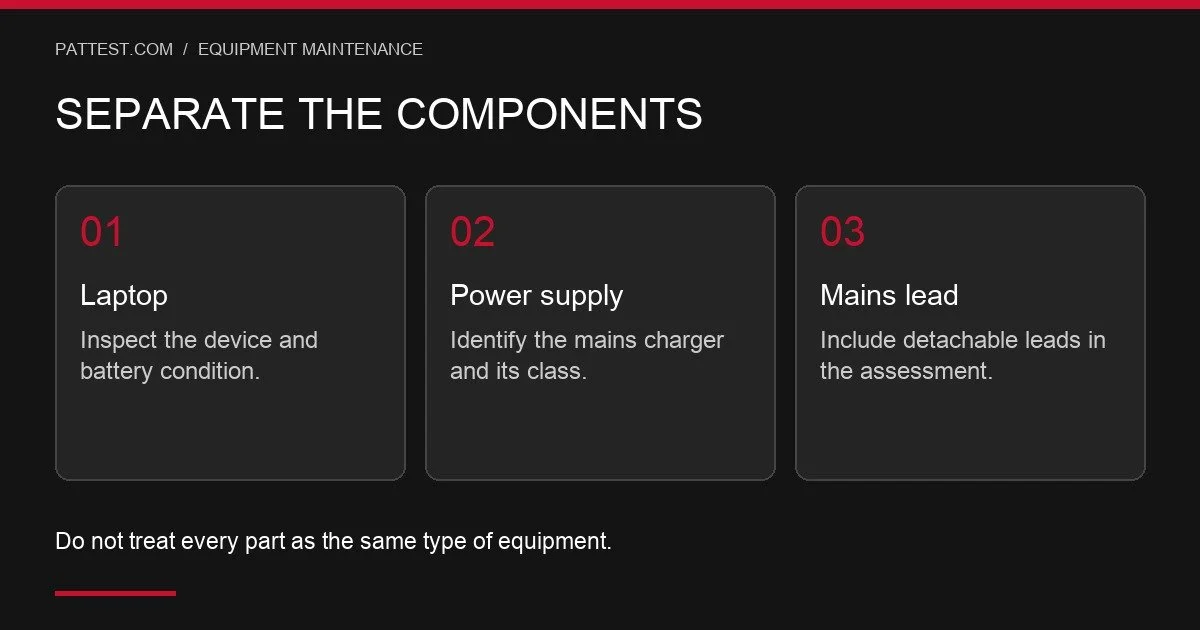
Laptops need a maintenance decision, not an automatic instrument test on every component: include the mains charger and supply leads. With an external DC supply, inspect the laptop rather than automatically applying a protective-earth test.
Identify charger and detachable lead separately from markings and construction. There is no universal legal annual PAT requirement.
Myth: the laptop needs a PAT sticker as a whole
A manufacturer's laptop manual, for example, specifies a mains-input adapter producing 19.5V DC; the machine normally uses that external supply and its internal battery, so inspect casing, charging connection, ventilation and battery condition rather than assuming a metal case needs a protective-earth test. Distortion, a lifting trackpad, gaps or an unexpected bulge can indicate a swollen battery: manufacturer guidance says stop use and charging, disconnect the adapter and arrange support. Do not flatten the case, puncture the battery or force it out; arrange appropriate assessment, because a charger pass cannot resolve that defect. Where testing is appropriate, a competent person selects construction/manufacturer-suitable insulation-resistance, protective-conductor or touch-current methods, with alternatives for sensitive electronics.
Myth: the laptop is Class II by default
The laptop's DC supply does not establish Class II: that construction uses double/reinforced insulation rather than protective earth, identified from the double-square marking/manufacturer information, not a plastic case or three-pin plug. Class II FE adds functional earth for electronics/interference control without changing that insulation-based protection; some laptop chargers use it, but neither every charger nor the laptop thereby becomes Class II FE.
The industry guide distinguishes Class I, Class II, Class II FE and Class III, with Class III relying on separated extra-low-voltage supply: reduced voltage alone cannot establish class, so check markings/instructions, assess the mains supply separately and seek competent advice if unclear.
Class II has no protective earth whose continuity must be demonstrated; see Class 1 and Class 2 appliances.
Myth: the mains charger is out of scope
HSE includes mains-connected battery chargers as portable equipment, but says low-risk Class II equipment needs appropriate user checks/visual inspection, not routine instrument testing.
Safely disconnected, inspect plug body/pins/overheating, fuse, rewirable-plug wiring/terminals/cord grip, cable cuts/crushing/taped joints, strain relief at plug/charger/connector, casing cracks/separation/heat damage and damaged/intermittent connectors; INDG236 covers plug, cable, casing, overheating and grip checks, while only the fuse can be checked internally in a moulded plug.
Meet ventilation/heat-dissipation requirements and manufacturer instructions, because covering devices/chargers traps heat. INDG236 rev3 (2013) distinguishes the following low-risk categories:
- Rarely moved desktop computers, VDU screens and photocopiers/fax machines: visual 2–4 years; combined testing No if double insulated, otherwise up to 5 years.
- Class II, not hand-held, moved occasionally: visual 2–4 years; combined testing No.
- Hand-held Class II: visual 6 months–1 year; combined testing No.
- Cables/leads/plugs, mains extensions, charging equipment: visual 6 months–4 years; combined testing 1–5 years, depending on connected equipment.
Myth: a battery-operated phone needs PAT testing
HSE excludes the battery-operated phone itself; that does not exclude its mains charger. The intervals above are suggested starting points, not legal rules or an automatic charger timetable: HSE says Class II leads/plugs should be maintained with equipment, and non-dedicated leads individually where appropriate.
A bag-carried charger is not necessarily “hand-held” in the table's operating sense, and commuting equipment is not rarely moved: assess actual handling and damage exposure. Where required, insulation/touch-current assessment addresses insulation protection; Class II FE functional-earth continuity is only a functional check, not protective-earth proof, so neither fail it as Class I nor select high-current earth testing or default voltage blindly.
Myth: cheap chargers are fine if they charge
Low price alone does not prove a charger unsafe: Electrical Safety First warns of substandard/counterfeit chargers, recommends compatible products from reputable sources and says names/conformity marks can be faked; retain model/supplier details, buy suitable traceable equipment and see fake phone chargers.
A charging light is not a safety result: HSE says most defects are visually detectable and some cannot be found by testing alone, while the industry guide recommends asking users about known/intermittent problems, including charging, unusual heat or damage that appears only with cable bending. HSE says remove damaged/faulty equipment without delay for competent repair or disposal preventing reuse: mark failed chargers, exclude them from shared drawers, never tape damage and return them, and retain repair/follow-up evidence before reuse or replace compatibly. A replacement charger does not close an unresolved laptop battery fault.
Myth: one sticker covers the laptop and charger
Identify the detachable mains lead independently or explicitly within the set: the practical guide specifies earth continuity, insulation resistance and polarity for three-core appliance leads, but insulation resistance/polarity without an earth test for two-core leads; testing only the brick leaves the lead unaccounted for, including its plug/appliance connector; inspect low-voltage output leads/USB cables for condition and connectors, not as mains extensions.
HSE says frequency depends on equipment/environment and maintenance should be reviewed against faults: fixed desks may protect cables, while hot desks pull/swap them and loan laptops may return with different chargers, warranting reassessment rather than universal annual tests. Record supplied chargers/leads, check at issue/return, simplify defect reporting and review docks/desk extensions too. Combined testers need suitable equipment, ability to use it and competence to interpret results; our PAT testing service selects checks for the equipment, not one desk-wide sequence.
PatTest.com offers PAT testing for landlords, duty holders and premises managers across Northamptonshire, Leicestershire, Warwickshire, Bedfordshire, Buckinghamshire and the wider Midlands, working from Kettering.