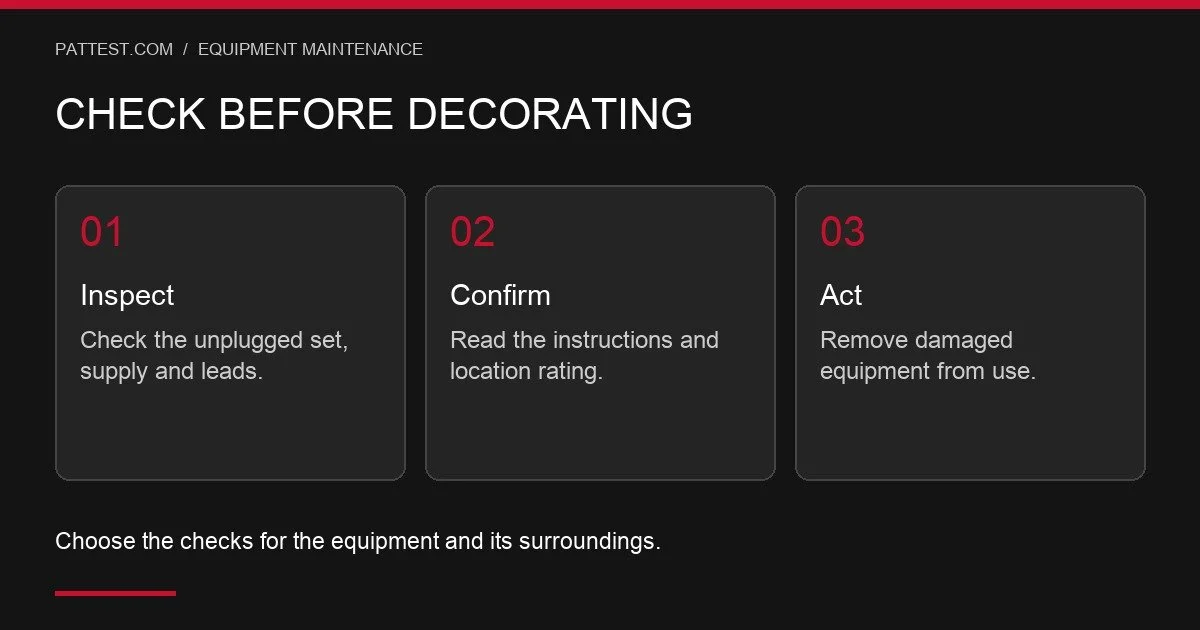
PAT testing Christmas lights starts with inspection, not a sticker: unpack each set, disconnect it, check from plug to last lamp, and remove damaged equipment from use. Plug-in lights, mains transformers and extension leads belong in workplace maintenance, but not every set needs electrical testing. HSE says the Electricity at Work Regulations 1989 do not require annual PAT testing: method and interval depend on risk.
Before you plug anything in
- Unpack and disconnect. Inspect the full length unplugged; HSE's INDG236 user checks cover damaged leads, plugs, taped joints, poor cable retention and overheating.
- Check the cable. Look for cuts, split insulation, heavy scuffing or exposed conductors.
- Examine the plug. Stop for cracks, damaged pins, scorching or staining around the plug or supply unit.
- Inspect connections. Reject taped joints, improvised connectors and cable pulled loose from entry points.
- Check cable retention. Look for missing or ineffective grips and coloured inner wires where the sheath should be secured.
- Inspect fittings and controller. Check for cracks, loose parts, damaged housings and moisture.
- Examine the transformer. Resolve damage, overheating marks or uncertain identity before installation.
- Match supply and set. Keep the correct transformer; check rated voltage on product or instructions, since sets may use mains or extra-low voltage.
- Confirm outdoor suitability. Follow instructions: only outdoor-designed lights belong outside, with plugs and transformers kept indoors.
- Read the IP code. Its final digit concerns water ingress; Electrical Safety First says outdoor Christmas lights should have at least three.
- Check supply arrangements. Electrical Safety First advises 30mA RCD protection outdoors, no overloaded sockets and fewer unnecessary extensions or adaptors.
- Include extension leads. Specialist guidance says test them, avoid overloads, fully unwind them, and route clear of trips, tight bends and cable-straining fixings.
- Identify construction class. Follow manufacturer instructions before deciding appropriate tests.
What each check is looking for
Components, not just lamps. Identify mains plug, power supply or transformer, controller, string and extension separately. HSE says cables dedicated to Class II equipment should be maintained with it, while independent leads may need maintenance as individual items. Battery lights differ from mains sets; LED does not establish construction class, and an extra-low-voltage string does not establish its mains transformer's class. See Class 1 and Class 2 appliances and what PAT testing tests.
User checks versus formal inspection. A competent inspector checks terminals, cord grip and correct fuse where a plug opens; moulded plugs are not opened for this, and HSE says only their fuse can be checked internally.
Tests matched to construction. Specialist guidance distinguishes Class I, Class II and extra-low-voltage arrangements; many modern sets have no accessible conductive parts for insulation testing. Class I relies on protective earth: relevant checks include visual inspection, earth continuity, insulation resistance and a functional check. Class II uses double or reinforced insulation, not protective earth, so no protective-earth continuity test applies; HSE emphasises casing integrity and visual checks.
Class II test limitations. Where electrical testing is appropriate, insulation resistance or touch-current testing may suit the construction. A test-equipment manufacturer's guide describes touch current as an alternative where insulation testing is inappropriate: technical guidance, not legislation or permission for an untrained user to energise suspect equipment. Its specialist Christmas-lights FAQ describes visual inspection, insulation resistance and functional checks with accessible conductive parts; without a suitable accessible part, thorough visual inspection may be all that can be done.
Damage means stop. Do not power exposed conductors, scorching or taped repairs to see whether lights work. HSE says remove faulty equipment without delay for competent repair or disposal preventing reuse. Competent repairs are not equivalent to twisted wires under tape; replace sets that cannot be safely repaired to their design and instructions, and Electrical Safety First says replace sets whose failed lamps are not replaceable.
Location matters. Storage can cause damage; specialist guidance distinguishes displays accessible to children from those out of reach in dry offices. Outdoor-rated strings do not make controllers, transformers or connections suitable for puddles: check each component's instructions and resolve missing or unreadable identification before installation. IP markings supplement instructions, not override them; include extensions in maintenance.
Storage and next season's checks
Record findings: recurring cable damage calls for changed storage or installation, not another sticker. Electrical Safety First advises unplugging lights before going out or going to bed.
HSE's PAT FAQ, checked in November 2026, bases frequency on equipment and environment; INDG236 calls annual testing of every portable appliance in a low-risk workplace a myth. Its 2013 leaflet suggests these initial intervals for relevant low-risk categories:
- Hand-held, double-insulated Class II: formal visual inspection every 6–12 months; no combined inspection and testing suggested.
- Earthed Class I: formal visual inspection every 6–12 months; combined inspection and testing every 1–2 years.
Both include user checks: these examples do not classify every Christmas set as hand-held or prescribe one programme for every display. Outdoor use, repeated installation, rough storage and frequent handling can change risk. Pre-installation checks each December are sensible, not evidence of a statutory annual test: HSE places risk-based interval decisions with the dutyholder and distinguishes guidance from compulsory requirements.
For communal halls or reception displays, inventory each set, supply, location and responsible checker. Get boxes out early enough for checks before installation, and include seasonal equipment when booking PAT testing, not after the engineer leaves.
From our Kettering base, PatTest.com provides PAT testing of Christmas lights, transformers and extension leads for landlords and premises managers across Northamptonshire, Leicestershire, Warwickshire, Bedfordshire, Buckinghamshire and the wider Midlands.