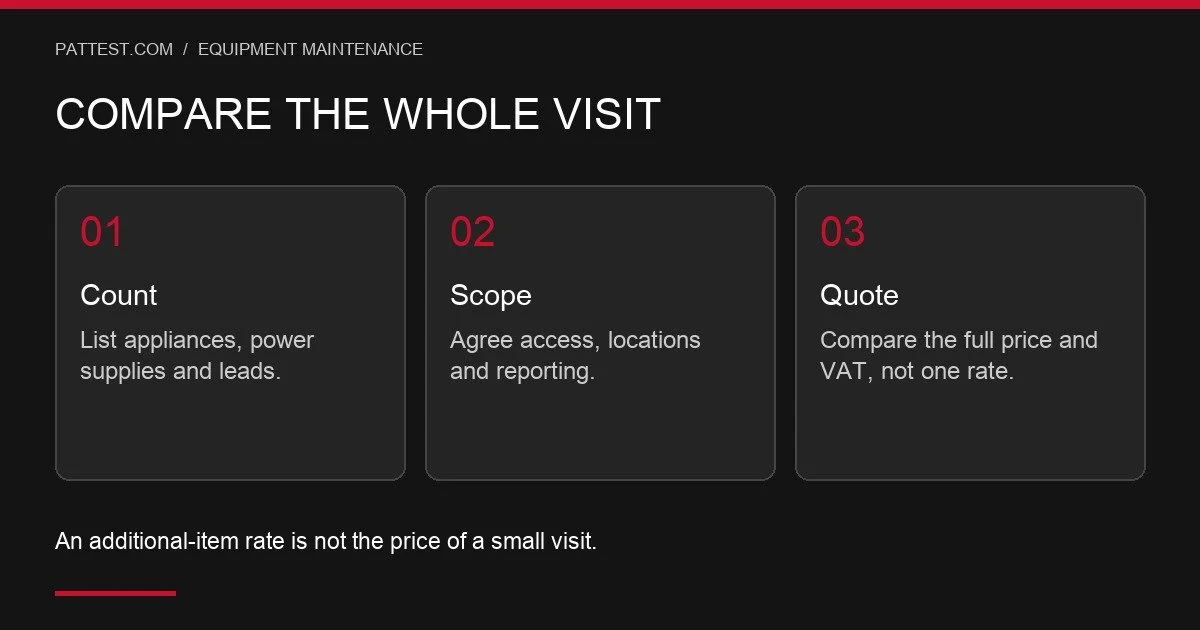
PAT testing visits start at £49 plus VAT; travel, small repairs, plugs or fuses and PDF certification are listed as included. On the published 50–200-item structure, 100 items cost £103.50 before VAT: £59 for the first 50, then 50 at £0.89. The visit charge and job size matter more than the lowest headline rate. Ask for a total covering your count, locations and access.
The published price bands
Our prices page gives visit packages; the PAT testing service page gives additional-item rates. As checked in November 2026:
- Smallest visits: banded charges start at £49 plus VAT, with a £59 plus VAT band for larger small jobs.
- 50–200 items: first 50 cost £59 plus VAT, then £0.89 plus VAT per additional item.
- 200-plus items: £0.79 plus VAT is the published lower additional-item rate, alongside the first-50 charge.
- 2,000-plus items: a custom quote is required.
- Included: engineer attendance at a home or business, travel both ways, testing, pass/fail stickers, small repairs needed to pass, new plugs or fuses where required, and PDF certification.
The small-visit bands overlap without a stated boundary. The 200-plus wording does not explain precisely how the lower rate applies alongside the first-50 charge. Ask for a written quotation; do not apply a bulk extra-item rate to an entire small property.
Example 1: a small visit
Ten items on a £49 visit = £4.90 per item on average, before VAT. That average does not contradict the larger-job rate: it reflects a visit package, not ten extra items added to a larger batch.
A national home-services cost guide describes hourly charging for smaller jobs and per-item pricing for larger commercial batches, with minimum call-outs covering time and travel and unit costs potentially falling as quantities rise. That explains the structure; its national or regional estimates are not PatTest.com's prices or a quotation for your premises.
Example 2: 100 items
£59 + (50 × £0.89) = £59 + £44.50 = £103.50 before VAT.
The first charge covers 50 items; the other 50 use the additional-item rate. This illustrates the advertised ladder, subject to agreed scope and quotation, not a promise that every 100-item site will be handled identically.
Someone must attend, identify equipment, inspect it, perform appropriate tests and record results. HSE emphasises visual inspection because testing alone cannot detect every electrical safety defect. Larger accessible batches spread visit-level work over more equipment; they do not justify less attention per item.
Example 3: 250 items — confirm the rate application
If £59 covers the first 50 and £0.79 applies to all 200 remaining items: £59 + (200 × £0.79) = £217 before VAT.
That is a conditional calculation, not a confirmed 250-item price. The published 200-plus rate application is unclear, so obtain a written quote rather than assuming this interpretation.
An extra-item rate applies under the quoted band; an average cost per item divides the complete invoice by the final count. Compare agreed complete prices and ask what happens if the final count differs from your estimate.
What can change the quoted figure?
Send an equipment list, not just desks or bedrooms. Identify appliances, separate power supplies and extensions, and ask how they are counted: HSE says dedicated Class II cables should be maintained with their equipment, while independent leads may need individual maintenance.
Disclose these conditions; they are not automatic surcharges:
- Access: locked rooms, occupied bedrooms, restricted areas or hard-to-reach equipment.
- Timing: out-of-hours work, narrow shutdown windows or processes needing interruption planning.
- Buildings: addresses and rooms, and whether one coordinated visit or separate appointments are expected.
- Equipment: known damage, unusual machinery, sensitive equipment or items already withdrawn.
- Reporting: asset identifiers, room-by-room schedules or other requirements.
Ask how these affect scope and price: a routine package neither automatically excludes them nor covers every arrangement. Do not add assumed travel or minor-repair fees; listed travel and small repairs are included. That does not promise an appliance rebuild, replacement or substantial repair. HSE says damaged or faulty equipment should be withdrawn without delay for competent repair or disposal, whatever suits the budget. Flag known faults and agree treatment of work beyond included plug or fuse repairs.
Compare inclusions, not just unit rates: are attendance, report, labels and routine plug or fuse work included? Ask whether every named building and certification are covered, and agree what happens if more extensive repairs are found. Seek approval before separately agreed work proceeds, not after the visit.
Budgeting for repeat visits
Recurring spend depends on inspection and testing intervals, not just one visit's price. HSE's PAT FAQ, checked in November 2026, says the Electricity at Work Regulations 1989 do not require annual testing; frequency depends on equipment and environment.
INDG236, HSE's 2013 low-risk guidance, calls universal annual PAT a myth and distinguishes user checks, formal visual inspection and combined inspection and testing. Different equipment groups may follow different programmes: the dutyholder decides the next-test interval through risk assessment, using fault records to review maintenance.
Do not simply extend intervals to save money. Consider use, surroundings, condition, previous findings and any contract or insurance requirement; the plan should explain decisions, not merely reduce visits. Keep appliance maintenance separate from fixed-installation checks. See why PAT testing is not a legal annual requirement and the landlord's guide to PAT testing.
PatTest.com provides PAT testing from a Kettering base across Northamptonshire, Leicestershire, Warwickshire, Bedfordshire, Buckinghamshire and the wider Midlands; send counts, buildings and access restrictions for a whole-visit quote covering equipment, records and VAT.