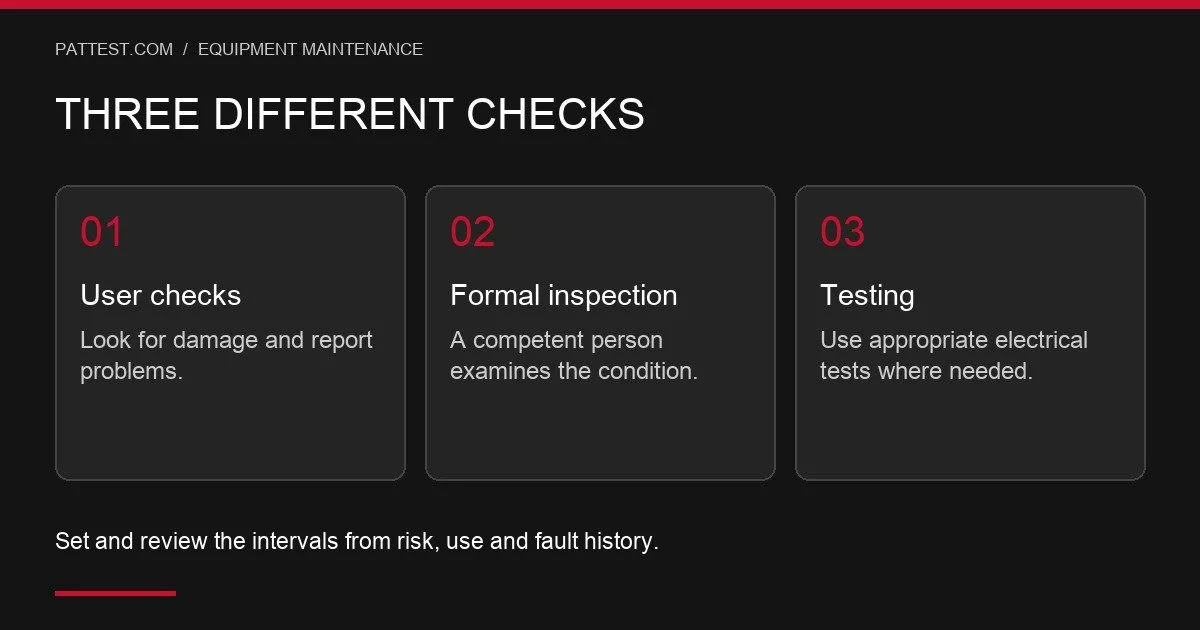
No regulation sets a PAT testing interval. Regulation 4(2) of the Electricity at Work Regulations 1989 requires maintenance to prevent danger, so far as is reasonably practicable, without naming a period. HSE offers suggested starting points, adjusted for equipment, environment and your records. Find the relevant category below; a test interval does not replace its separate user checks and formal visual inspections.
Office IT rarely moved
INDG236 rev3, published in 2013, gives initial intervals for low-risk offices and shops.
Desktop computers, VDU screens, and non-hand-held, rarely moved photocopiers and fax machines:
- User check: No.
- Formal visual inspection: 2–4 years.
- Combined inspection and testing: No if double insulated; otherwise up to 5 years.
Double-insulated Class II equipment, not hand-held and moved occasionally, such as fans and table lamps:
- User check: No.
- Formal visual inspection: 2–4 years.
- Combined inspection and testing: No.
These and the following low-risk equipment entries reproduce INDG236 Table 1. Distinguish equipment left in position from equipment dragged between rooms: usage matters more than its name.
Earthed Class I kitchen-type equipment
Electric kettles, irons, some floor cleaners and kitchen equipment:
- User check: Yes.
- Formal visual inspection: 6 months–1 year.
- Combined inspection and testing: 1–2 years.
A kettle may need all three activities; double-insulated office equipment may need inspection without an instrument test. Treat these as separate decisions, not one combined booking.
Hand-held and portable tools
Double-insulated Class II hand-held equipment, such as some floor cleaners and kitchen equipment:
- User check: Yes.
- Formal visual inspection: 6 months–1 year.
- Combined inspection and testing: No.
A cleaner dragged between rooms has different damage exposure from a fan left on a shelf; do not apply an office timetable to tools exposed to site conditions.
Construction: 230V equipment
HSG107, third edition, published in 2013, gives these construction entries in Table 1.
- User check: Daily or every shift.
- Formal visual inspection: Weekly.
- Combined inspection and testing: Before first use on site, then monthly.
These are suggested initial maintenance intervals, not statutory test deadlines. An office timetable is not a substitute for the construction row.
Construction: 110V equipment
- User check: Weekly.
- Formal visual inspection: Monthly.
- Combined inspection and testing: Before first use on site, then every 3 months.
The weekly user-check entry belongs to 110V; daily or every shift belongs to 230V. Neither suspends action on damage: a three-monthly test does not make a damaged drill safe until its next appointment.
Wet, dusty and harsh environments
- User check: Review against actual conditions rather than assuming an office regime.
- Formal visual inspection: Review the relevant equipment starting point for harsher exposure.
- Combined inspection and testing: Review whether more frequent inspection and/or testing is needed; HSG107 calls for this in more demanding conditions.
HSE identifies harsh environments, unsuitable use, wet/dusty storage and trapped cables as concerns. The IET identifies users, construction, equipment type and frequency of use as interval-setting factors. A mostly-office building containing a kitchen, cleaner's cupboard or workshop needs separately planned environments, not an averaged site date.
Record whether leads are flexed, pulled or trapped; water, dust or cleaning products can reach equipment; items are hand-held, frequently moved or used by changing users; defects are recognised/reported promptly; and manufacturer operating/maintenance instructions are followed. Near water, check suitability too: frequent testing cannot make an indoor appliance suitable for manufacturer-excluded conditions.
Cables, leads and charging equipment
Cables, leads and plugs connected to the low-risk equipment above; mains extension leads and battery-charging equipment:
- User check: Yes.
- Formal visual inspection: 6 months–4 years, depending on connected equipment.
- Combined inspection and testing: 1–5 years, depending on connected equipment.
HSE says leads/plugs connected to Class II equipment should be maintained with it; non-dedicated leads should be maintained individually where appropriate. A shared travelling extension differs from a cable fixed behind a desk.
“No” in a user-check entry is not permission to ignore cracked plugs or burning smells: damaged/faulty equipment should be removed without delay. INDG236 also says: “Following the guidance is not compulsory, unless specifically stated.” The upper end is a starting position, not permission to leave damage until the next booking.
Guidance, ownership and records
Legal boundary. Regulation 4(2) is an outcome-based maintenance duty for work activities in Great Britain. It prescribes no annual portable appliance test. Northern Ireland has separate legislation; these tables do not summarise every housing/sector duty. HSE says the Regulations specify neither what must be done, by whom nor how frequently. A contractor's reminder is not a statutory deadline; see why PAT testing is not a legal annual requirement. Check insurer, lease and client conditions separately: a contractual interval is not a universal legal one.
Industry guidance. The IET Code of Practice is not legislation; its fifth edition appeared in 2020. It removed the previous frequency table without replacement, describing risk assessment instead. Read HSG107's older IET-table reference historically. Our PAT testing service helps identify equipment groups and appropriate checks rather than treating every plug alike.
Decision owner. INDG236 says: “The person carrying out the test should not assess when the next test will be due as this decision should be made by you on a risk assessment basis.” Competent advice informs dutyholder judgement, not a fixed annual rule. Establish unclear construction class from markings/manufacturer information; Class 1 and Class 2 appliances explains the earth connection. Ask contractors which maintenance activities their visit covers: “PAT included” is incomplete.
Documented review. HSE says ordinary PAT records/labels are not legally required, but help demonstrate and review maintenance. Record equipment group, location, class, conditions, selected checks/intervals and review owner, alongside findings, applicable results, repairs/disposal and triggers such as harsher conditions, changed users or repeated defects. An accessible, actionable spreadsheet suffices; an unopened folder does not. HSG107 advises against next-test-due dates on labels: future dates belong in the schedule, decided by the dutyholder's risk assessment. Stickers record past checks, not future promises.
Adjusting from the starting point
Fault history. HSE says few faults may justify longer intervals; common faults may require shorter intervals or other risk-reducing action. Look for repeated damaged plugs, loose cord grips, crushed leads and equipment returning from repair. Include between-visit reports: prompt replacement can erase a group's unreliability from test-day results. Shorten the affected interval while investigating cable routing, storage, equipment choice or training; repeatedly finding a defect is not preventing it.
Extensions. Record a deliberate reason for a defined group, not a blanket extension based on good computer results. Mixed groups tested together should use the shortest interval or be grouped by interval instead. Shorten when evidence is thin: extra inspection costs are visible, unlike the consequences of an excessive interval.
PatTest.com provides PAT testing for landlords, duty holders and premises managers from Kettering across Northamptonshire, Leicestershire, Warwickshire, Bedfordshire, Buckinghamshire and the wider Midlands.