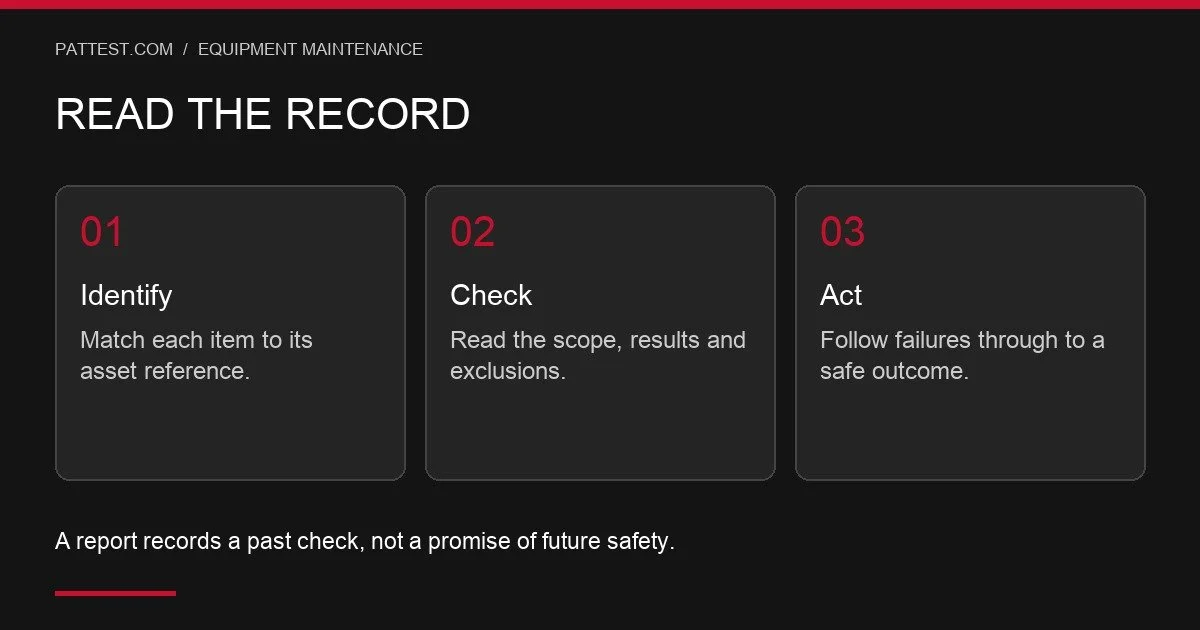
A PAT testing certificate records a contractor's appliance inspections and results; it has no universal legal expiry date. HSE says the Electricity at Work Regulations 1989 do not prescribe annual PAT testing: intervals depend on equipment and environment. Check the inventory against your equipment and any contract or policy requirements.
Is a PAT certificate government-issued?
No. It is the contractor's record of appliance inspections and test results, not a government-issued statutory certificate. HSE's PAT FAQ, checked in November 2026, says there is no legal requirement under the general PAT maintenance regime to keep inspection and testing records or to label checked equipment, though both are useful management tools for monitoring the maintenance scheme and demonstrating that one exists. The report is evidence for equipment management, not a licence to operate the building, and HSE's statement does not cancel a housing requirement, contract or insurance condition on a particular premises.
Does a PAT certificate expire?
There is no universal annual expiry. A policy, letting agreement, contract or site procedure may specify an interval or evidence period: read its wording rather than assuming everything expires after twelve months. Clarify scope and meet any annual condition, but do not invent one or borrow another organisation's interval. Maintenance is ongoing: absence of universal expiry never justifies leaving damaged equipment in use.
What does the date on the front page mean?
It may be the contractor's recommended review date, an interval agreed with the client, or a reminder generated by the reporting system; ask which, because a printed date does not by itself establish a statutory deadline. HSE says frequency depends on equipment type and environment, and INDG236, its 2013 leaflet for low-risk environments, gives suggested initial intervals and says the dutyholder should decide when the next test is due on a risk-assessment basis. Keep the inspection date separate from the review date in your register; our article on why PAT testing is not a legal annual requirement sets out the distinction.
What should be on it?
In everyday PAT work a certificate usually means a report package: a summary plus an item-by-item schedule, and NICEIC's consumer guidance describes receiving an inventory documenting the results for each appliance tested. No statutory layout is prescribed, so this is a recommended specification rather than a legal form, and field-service software guidance likewise recommends appliance descriptions, unique asset references, inspection dates, measured readings, tester details and risk-based retest recommendations. A useful schedule gives the client, address, visit date, buildings and scope, including exclusions, unavailable rooms and equipment that could not safely be disconnected; it identifies the tester and instrument, ideally by make, model and serial number, and gives each appliance an identifier, description, location, class, pass/fail result, defects and remedial action. Class helps explain applicable tests; if procurement requires accuracy assurance, ask how the instrument is maintained, and distinguish risk-based next-check recommendations from contractual deadlines.
Which readings should appear?
Look for the visual inspection outcome, not just a final pass, and where testing was appropriate and performed ask for measured results — earth continuity, insulation resistance or touch current — with units. The report should distinguish a test that was not applicable from one that was not completed. HSE says visual inspection remains essential because testing alone cannot find every type of defect. Do not demand a number in every box: recording why a test was unnecessary is more honest than a meaningless reading.
Does every appliance need an electrical test?
No. HSE's guidance says some equipment in low-risk environments needs user checks and visual inspection rather than a combined electrical test. A schedule with blanks can therefore be complete if it says why, and HSE's low-risk leaflet places the interval decision with the dutyholder on a risk-assessment basis.
Is the sticker part of the record?
It is a signpost, not the record: a label helps a user identify an appliance and see its recorded status without opening a report. NICEIC describes a pass or fail label with the inspection date alongside the inventory, while HSE describes labelling as useful rather than a general legal requirement. The sticker cannot carry the whole history — it does not explain a marginal result, identify an excluded test or show a repair — so match its asset reference to the schedule. Nor does a green sticker override visible damage: HSE says a result indicates condition at the time of the test and does not imply safety for a further period, and user checks continue.
Do I have to keep it, and where?
Under the general regime there is no legal requirement to keep records, though HSE describes them as useful management tools. Retain earlier reports so you can compare the same item over time and show what happened to previous defects, because comparison only works if the previous information remains available. There is no universal PAT retention period in the HSE FAQ, so set your policy by the equipment's history and any applicable contractual, housing, insurance or organisational requirements, and do not call an arbitrary number of years a statutory rule. Store the complete report and schedule together, not just a photograph of the summary page; for a small premises a clearly named PDF folder and equipment spreadsheet may be enough if the next manager can follow it without searching a former employee's inbox.
What if an appliance fails?
Remove it from use and tell the person responsible. NICEIC says failed appliances should be taken out of service and repaired or disposed of; HSE likewise describes competent repair or disposal of faulty equipment. Record the defect, the action and the outcome of checks after repair.
What about a brand-new appliance?
If you buy a new appliance, HSE recommends a simple visual check for damage rather than assuming a formal PAT is necessary solely because it is new. A replacement needs its own identity in the register.
Does the certificate cover the building's wiring?
No. A report does not prove the fixed installation is satisfactory, cover equipment absent from the visit, or establish that every feature works. Read the recorded scope; what PAT testing tests covers the checks and their limits.
What if the inventory does not match my equipment?
A schedule showing appliances present, passed, failed or unchecked tells you more than a premises-tested heading. Entries must distinguish similar items — several office kettles, for example — and missing equipment needs querying before filing. When booking PAT testing, ask about report scope and how failed, inaccessible and inspection-only items appear; our prices page includes PDF certification.
PatTest.com carries out PAT testing across Northamptonshire, Leicestershire, Warwickshire, Bedfordshire, Buckinghamshire and the wider Midlands from a Kettering base, for landlords, duty holders and premises managers who need records they can act on.