
Product safety dominates the week. The Office for Product Safety and Standards rejected a batch of cordless pruning shears at the border over an adaptor insulation fault and recalled a set of Christmas LED curtain lights whose plug cannot make a proper connection to the socket. The National Fire Chiefs Council used Black Friday to warn that most shoppers never register small electrical appliances, so they miss recall notices, while London Fire Brigade released footage of a battery fire reaching flashover in two minutes. On the fire side, a sprinkler contained an e-bike battery fire in a rented Derby house, a large commercial fire in Bexleyheath was recorded as accidental with an undetermined cause, and two London fires — one fatal — remain under investigation.
Electrical safety
Pruning shears rejected at the border over adaptor insulation
27 November — OPSS product safety report. The Office for Product Safety and Standards reported that a batch of blue cordless electric pruning shears, supplied with rechargeable battery packs and a carry case, presents a serious risk of electric shock because the supplied adaptor does not meet the insulation requirements between the mains input and the low-voltage output circuits. OPSS says that if the insulation breaks down, mains voltage could be transferred to the output connector or connected equipment. The declaration of conformity and technical documentation could not be linked back to the pruning shears, and the warnings, markings and instructions needed improvement.
The product did not meet the Supply of Machinery (Safety) Regulations 2008 or the Electrical Equipment (Safety) Regulations 2016, and the import was rejected at the border and destroyed. It was sold via Amazon, with adaptor model HGFS210100.
Who it affects and what to do: grounds maintenance teams, hire fleets and workplaces that bought these shears should check the adaptor model against the notice before the next job. A border rejection means the affected stock was stopped before sale, but units already in use should still be identified from purchase records. Portable appliance testing confirms the appliance is safe as presented on the day; it does not redesign an adaptor, so a design fault recorded by the regulator is acted on separately through the product safety notice.
Christmas LED curtain lights recalled over a plug fault
27 November — OPSS product recall. OPSS reported that Hobbycraft Create & Celebrate Warm White LED Curtain Lights, product number 6844361000, present a risk of electric shock because the plug face does not conform to BS 1363 and cannot make a secure connection to the socket. The regulator says this could allow the user to touch the live and neutral pins while the product is plugged in, and that the plug contains no fuse, which is needed for safe operation under fault conditions and without which the plug could overheat or burst.
The product has been withdrawn from the market and recalled by Hobbycraft, and OPSS advises owners to stop using it immediately and return it to the nearest Hobbycraft for a full refund. It does not meet the Electrical Equipment (Safety) Regulations 2016 or the Plugs and Sockets etc. (Safety) Regulations 1994.
Who it affects and what to do: offices, shops, pubs and rented homes that put up decorative lighting for Christmas should check the plug before the lights go on display. Look for a plug face that seats properly in the socket and a fuse carrier that is present and correct, and treat a loose or rocking plug as a fault rather than a nuisance. Include decorative lighting in PAT testing before it goes up, and read our note on non-sleeved plugs if the pins look unfamiliar.
Black Friday: register what you buy and check the seller
26 November — National Fire Chiefs Council; 27 November — London Fire Brigade. NFCC reported that just 39 per cent of consumers registered an electrical appliance where registration was available, against 62 per cent for large domestic appliances such as washing machines and fridges. Research commissioned by OPSS found that 37 per cent of those who did not register did not know they could, and 35 per cent did not want to or did not think it necessary. Separate OPSS figures for 2025/26 record fire as the most frequently reported hazard, with 424 notifications accounting for 30 per cent of notifications involving unsafe products with an identified harm type.
London Fire Brigade's Black Friday and Cyber Monday campaign, running from 27 to 30 November, reports that crews attended 160 fires involving e-bikes and e-scooters between January and October 2026, after 206 such fires in 2025, around 83 per cent of them involving an e-bike. Its new footage shows a confiscated converted e-bike reaching flashover in a mocked-up bedroom within two minutes of battery failure, and the Brigade advises buying from reputable retailers and watching for missing CE or UKCA markings.
Who it affects and what to do: landlords furnishing rented flats, office managers replacing kitchen equipment and anyone buying gifts for premises should register the product with the manufacturer and keep the model and serial number in the appliance record used for PAT testing. Registration is how a recall reaches you directly; a test record alone will not.
Fire safety
Derby e-bike battery fire: sprinkler contained it, charging caused it
Fire on 14 November; warning published 26 November — Derbyshire Fire and Rescue Service. Firefighters from three stations were called to a two-storey rented property on Peel Street, Derby, at about 07:20, and a sprinkler system activated and contained the fire to the room where it started, allowing four people to evacuate safely. An investigation established that the fire was caused by an e-bike that had been left on charge.
The service's advice is to buy battery-powered products from reputable retailers, always use the correct charger, and avoid charging batteries unattended or overnight. It also highlighted the role sprinklers can play in containing a fire and supporting evacuation.
Who it affects and what to do: landlords of rented flats and HMOs, and anyone who charges an e-bike indoors, should review where charging happens. Keep charging away from escape routes, avoid overnight charging, and confirm smoke alarms work on every level. Where a fixed installation or sprinkler system is present, keep the EICR and maintenance records separate from the appliance register and note the containment measures in the fire risk assessment.
Commercial fire in Bexleyheath: ten pumps, cause undetermined
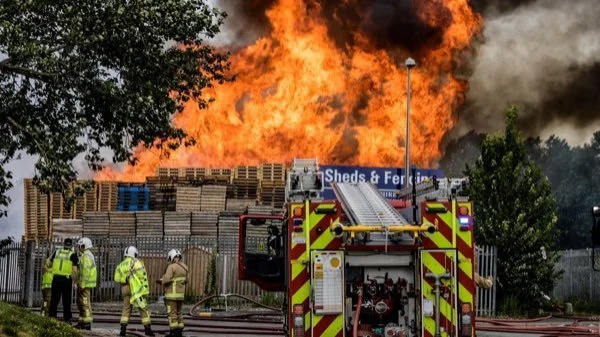
24 November — London Fire Brigade incident. Ten fire engines and around 70 firefighters responded to a fire on a roof terrace and car park on Broadway, Bexleyheath, where part of the first, second and third floors of a multi-storey building and car park were alight. There were no reported injuries, and residents nearby were advised to keep windows and doors closed because of heavy smoke. Control officers took the first of six calls at 01:57, crews from Erith, Bexley and Sidcup attended with Kent Fire and Rescue Service assisting, and the fire was under control at 04:17.
The Brigade says the fire is believed to be accidental and due to an undetermined cause, so the origin remains open rather than attributed.
Who it affects and what to do: duty holders for commercial premises and multi-storey buildings should use the incident as a prompt rather than a diagnosis. Review the fire risk assessment, confirm fire alarm servicing is current for the building's system, check emergency lighting testing records for the common areas and car park, and make sure fire extinguisher servicing covers the risks present.
Two London fires still under investigation, one fatal
26 November — London Fire Brigade incidents. Eight fire engines and around 60 firefighters were called to a flat fire on Regents Park Road, Finchley, where part of a flat on the sixth floor of a residential block was damaged; the fire was under control by 16:59 and the cause is under investigation by the Brigade's Fire Investigation Team. At a range of garages on West Ham Lane, Stratford, one fire engine attended and the incident was over for firefighters by 06:47, but one person died; the cause is under investigation by the Brigade and the Metropolitan Police Service.
Who it affects and what to do: landlords and managing agents should not read a cause into either incident yet. Check that communal alarms and escape routes were unobstructed, that fire alarm servicing is current, and that the fire risk assessment records what was found at the last inspection. Treat both causes as open until the fire service states one.
A free fire safety check for small businesses
24 November — London Fire Brigade. The Brigade launched a Business Safety Checker, a free online tool that asks up to 20 questions about a premises and returns tailored fire safety guidance and recommendations for the fire risk assessment. More than 800,000 premises in London fall under the Regulatory Reform (Fire Safety) Order 2005, and the Brigade says its inspection teams represent only a small proportion of the resources needed to visit every business. The tool initially covers food and drink, retail and office premises, which the Brigade's data show account for 41 per cent of fires in business premises.
Who it affects and what to do: small business owners and premises managers outside London can use the same questions as a structure for reviewing their own fire risk assessment. Work through the layout, occupancy and industry-specific risks, record the answers, and use the gaps it exposes to prioritise PAT testing, alarm servicing and extinguisher checks.
What to do this week
- Register new electrical purchases. Add the model and serial number to the appliance record kept for PAT testing, and register the product with the manufacturer so recall notices reach you.
- Check Christmas lights before display. PAT test decorative lighting, inspect the plug for a seated BS 1363 face and a fuse, and stop using anything that rocks in the socket.
- Identify affected stock. Compare adaptor and charger model numbers against current OPSS notices, including the pruning shear adaptor and any e-bike charging equipment.
- Move charging off the escape route. Charge e-bikes and battery equipment away from stairs and corridors, not overnight, and keep smoke alarms working on every level.
- Review the fire risk assessment. Use a structured checklist, record the findings, and note where sprinklers or other containment measures are fitted.
- Test the safety systems. Confirm fire alarm servicing, emergency lighting testing and fire extinguisher servicing are current for commercial and multi-storey premises, and keep the EICR for the fixed installation as its own record for HMO compliance.
For PAT testing, portable appliance testing, fire alarm servicing, fire extinguisher servicing, emergency lighting testing and fire risk assessments across Northamptonshire, Leicestershire, Warwickshire, Bedfordshire and Buckinghamshire, book a visit or view our prices.
